
Popping baits up off the seabed isn’t a tactic commonly used by most shore anglers. If you’ve yet to try it, you really have been missing out, as Mike Thrussell explains
Adding buoyancy to your baits helps to imitate the natural tendency of smaller food items to be lifted and dropped by the steady flow of waves and currents. It’s a tactic that works throughout the year, but it’s especially suited to periods when the sea is very clear during long spells of calm, settled weather, at any time of year. If the fish are lethargic and bite shy, this is the tactic to try!
WHAT POP-UPS TO USE
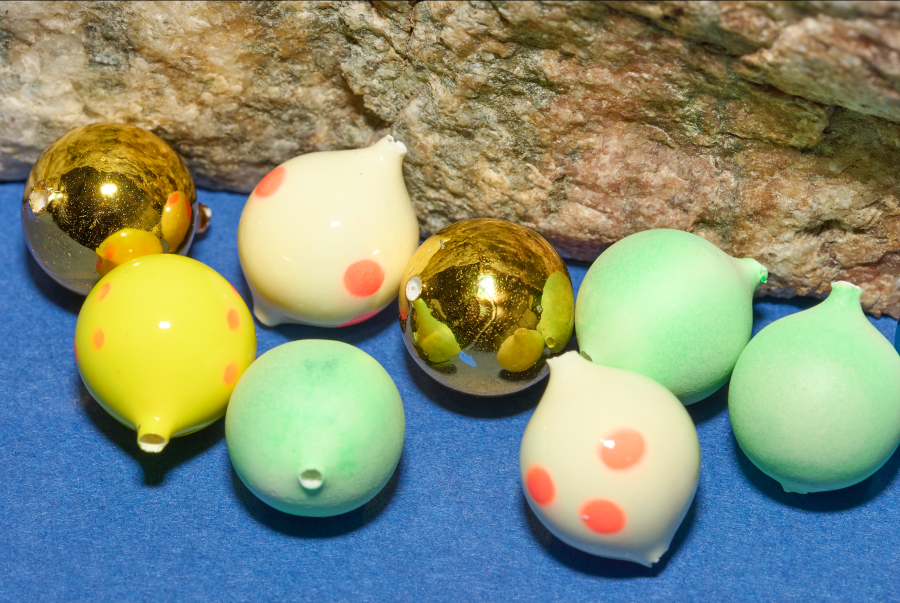
Pop-ups come in the form of hollow beads in various sizes that simply thread on the line. The bead is then trapped by a small stop knot tied on the hook trace with Powergum or clear mono. The beads range from 6mm to 12mm, but the smaller 6mm, 8mm and 10mm cover most normal baits and situations.
Modern thinking has seen the recent introduction of barrel-shaped pop-ups. These are made from a soft plastic that can be slid over the hook and onto the hook trace, so they can be added and removed at will without the need to remove the hook. They usually come in lumo green and white colours, sometimes in yellow, and cover the common sizes of 6mm, 8mm and 10mm.
Both the bead and the barrels can also serve as visual attractors. The silver, metallic-looking beads are best on days when you’re fishing in shallow water in bright sunshine, as the bead reflects flecks of light. In lower-light conditions and less clear water, white, pink, yellow and red can all have their day, and you can always mix two or three different colours to identify the best combination.
BALANCED BAITS
The key to getting the best bite ratio from a pop-up bait is to fine-tune the balance so it lifts easily and naturally as the water rises, yet slowly sinks back to the seabed as the flow eases. Bites tend to come just as the bait is falling back down. This is where having different sizes of beads or barrels with you gives balance options. It’s important to decide how big a bait you want to fish: single or small bunches of maddie rag, small chunks of king rag, or mackerel strip. Then play with the beads at the water’s edge until you get that neutral buoyancy just right. Also expect to shorten or lengthen the distance between the sliding beads and the hook using the sliding stop knot to increase the bite ratio. Three inches is a good starting point, and even more so if the water carries a hint of colour, when the beads’ colour attraction can be utilised. In clear water, you may need to extend this up to eight inches to get more movement into the bait, but also to minimise the visual impact of the beads being so close to the bait.
Pop-ups that hold baits up in the water column work best with smaller baits such as double maddie rag, small strips of mackerel, a bunch of peeled peeler crab legs, small prawns, and prawn chunks. By using a sliding stop knot between the bead/barrels and the hook, you can instantly adjust the distance between the bait and the beads. However, if you’re fishing in water, say, five deep, begin with a three-foot hook length, then experiment with the beads at various distances from the hook. What you’re trying to identify is the depth in the water column where the bulk of the fish are swimming. It’s usually mid-depth to just below the surface, so you may need to lengthen or shorten the hook length until you find it. The distance between the beads and the hook should be between three and six inches, but extend this if bites are slow to appear.
HOOK LENGTHS
It’s best to use lighter fluorocarbon hook lengths exclusively for this type of fishing as the aim is to induce movement and the more weight we add by using heavier diameter lines the less natural the bait behaves. Lines no heavier than 12lb and ideally 6-8lb can make a huge difference on the day. The lighter fluorocarbons are also much harder for the fish to see in the clear water.
It’s also an advantage to use fluorocarbon rig bodies for your rigs in nothing heavier than 20lbs and keep rig components such as swivels as small as possible and use clear rig beads. Two-hook rigs with one hook trace near the lead weight and the other a good 30-inches above it works well covering both near the seabed and the upper water column. Keep the hook lengths no longer than 15 inches on these. When needing a longer hook length to search the water column, use a one-hook rig again, with the hook length being positioned tight to the lead.
HOOK PATTERN CHOICE
Hook patterns also need to be chosen for lightness as this has a big influence on how much buoyancy is needed to balance the bait. You’re mostly targeting smaller species like black bream, mullet, flounder, scad, garfish, school bass, pollack, pout, poor cod and smaller wrasse so hook sizes don’t need to be bigger than a size 6 and often a short shank wide gape size 8 or 10 works best. Types to judge others by are Drennan Super Specialists and the Tronixpro Wormer hooks.
Always us the lightest lead you can get away with. Just 1oz is enough in calm, clear water as it can be moved easily to induce the bait to move when necessary. However, you’ll find that a bigger 2 to 3oz lead will set the hook in the fish better, especially when you’re using the longer three-foot-plus hook lengths.
SOFT TIPS
As we’re using lighter hook lengths and generally small hooks, the type of rod we use needs to be thought about. The best rods are the 10-foot Tipsters or Soft Tipped competition rods matched to a size 4000 fixed spool reel loaded with 20lb braid. The soft rod tip cushions the fight of any bigger fish you hook when using light hook lengths but also shows up very delicate bites from smaller fish.
Yes, there is some work involved in getting the balance of the baits just as you want them and experimenting with the hook lengths to get the fishing depth right, but this tactic is so effective it’s well worth the effort.