

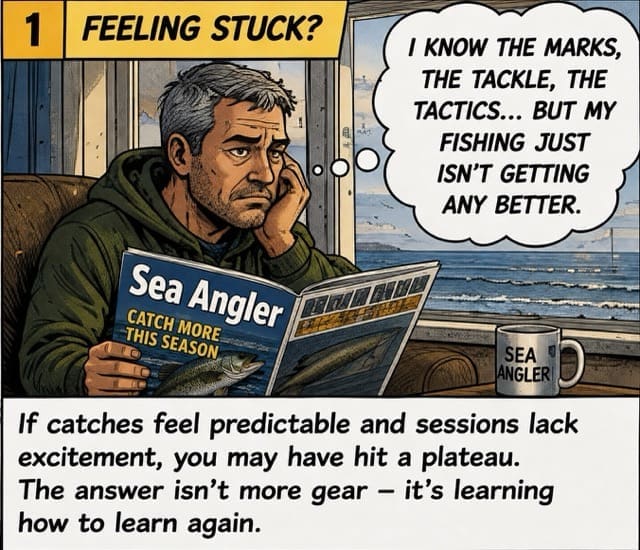
You’ve been fishing for years, know your favourite marks inside out and have tackle and tactics you trust. Yet somehow your catches aren’t improving. If you’ve reached a plateau, the answer isn’t necessarily more knowledge, better tackle or more time on the water. It’s learning how to learn again.
When you first start sea fishing, improvement happens quickly. You learn to cast further, tie better rigs, choose the right baits and understand how tides, weather and different species affect your chances. Blanks become less frequent, better fish appear and almost every season teaches you something new.
Then, somewhere along the way, progress slows. By now you’ve accumulated years, perhaps decades, of experience. You have favourite marks, trusted rigs and baits you know will catch fish. You’re an experienced sea angler, but are you actually getting any better?
Think about your fishing over the past few years. Are your catches noticeably improving? Are you learning more about the marks you fish, or are most sessions following a familiar pattern?
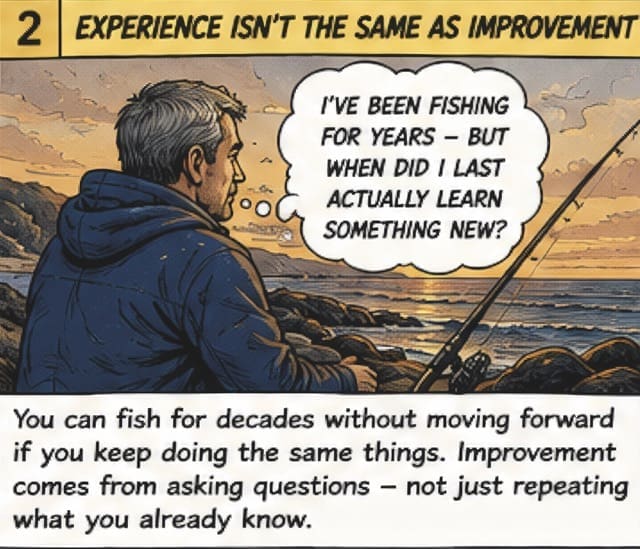
If the answer makes you slightly uncomfortable, you may have reached a fishing plateau. The important thing to understand is that experience and improvement aren’t the same thing. You can accumulate another ten years of fishing without becoming significantly better if those years largely consist of repeating what you already know.
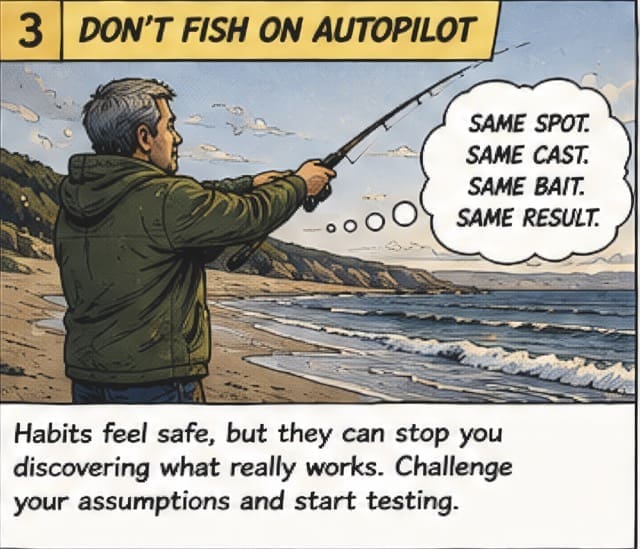
STOP FISHING ON AUTOPILOT
Experience is useful because it creates shortcuts. Arrive at a familiar beach and you probably know which rig you’ll use, which bait you’ll start with and roughly where you’ll cast. Most of those decisions will be perfectly sensible because they’re based on previous success. The problem begins when experience stops generating questions and starts generating assumptions.
Perhaps you’ve always cast as far as possible because that’s where you believe the better fish are. Maybe you’ve fished the same section of beach for years because you’ve caught there before, or automatically reach for the same bait combination regardless of the conditions. None of those things is necessarily wrong, but when did you last test whether they were right?
Fishing on autopilot will still produce fish. What it doesn’t necessarily produce is improvement. To break through a plateau you need to become curious about your fishing again, which is exactly where Sea Angler’s TIDE method comes in: TEST. INTERPRET. DECIDE. EXECUTE. TIDE isn’t another fishing technique and it doesn’t require different tackle. It’s simply a deliberate way of learning from what happens during every session.
TURN EVERY SESSION INTO AN EXPERIMENT
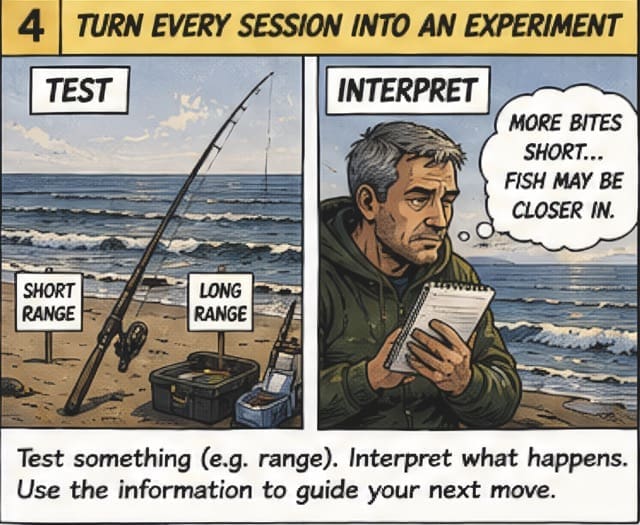
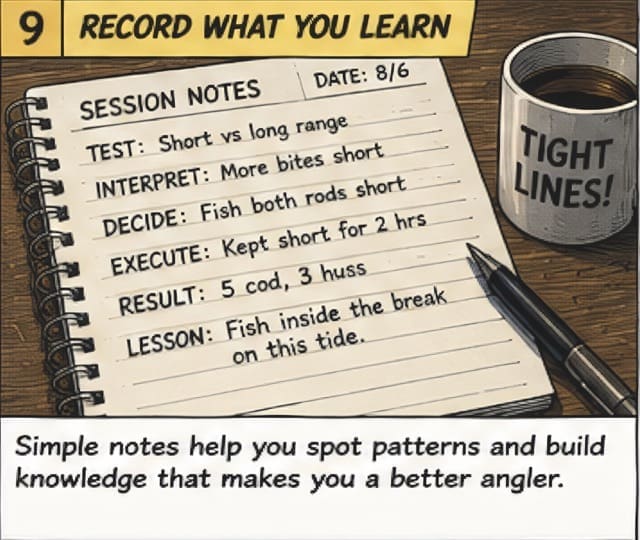
Imagine you’re fishing a familiar beach where you’ve always tried to hit maximum range. This time, rather than simply doing what you’ve always done, ask a question: Do I really need to cast this far? That’s the TEST. Fish one rod where you normally would and deliberately put the other bait 40 or 50 yards out. Keep everything else as similar as possible and see what happens.
After an hour, the long rod hasn’t moved while the short rod has produced three bites. Now comes INTERPRET. Don’t simply think, “I’ve had a few bites.” Ask why. Are fish feeding closer to shore than expected? Is there a feature at that distance? Is food being concentrated in the surf? Did the bites coincide with a particular stage of tide?
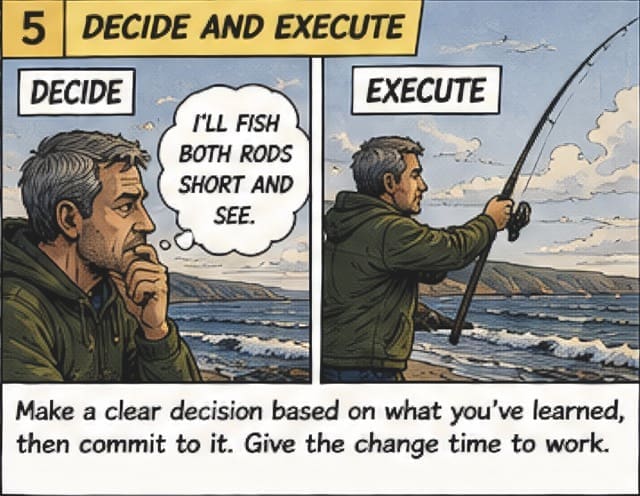
Next comes DECIDE. You might bring the second rod short and concentrate both baits where the action appears to be. Alternatively, you could leave one at range so you can continue comparing the two areas. There isn’t necessarily a single correct answer. What matters is that the decision is based on what you’ve observed rather than habit.
Finally, EXECUTE. Whatever you’ve decided, commit to it properly. Don’t give the change ten minutes, become impatient and revert to what you’ve always done. Give it enough time to provide useful information. Then start the process again.
Every answer creates another question, and every session adds something to what you know. That’s how TIDE turns ordinary fishing sessions into continuous improvement.
CHANGE ONE THING AT A TIME
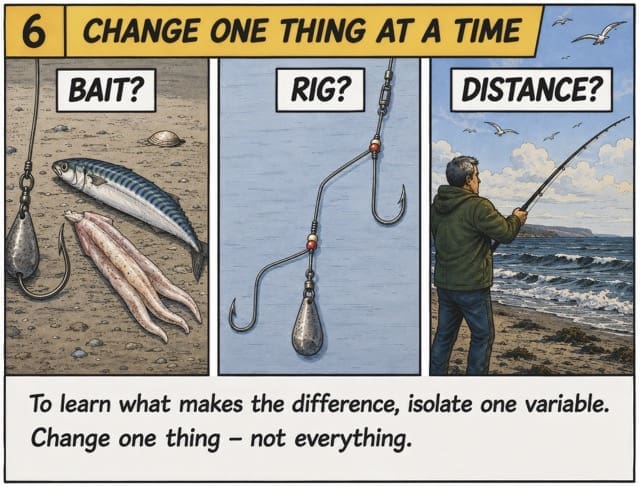
There’s another trap experienced anglers fall into when things aren’t going well. We start changing everything. The bait changes, then the rig, hook size, casting distance and perhaps even our position on the beach. Twenty minutes later we catch a decent fish, but what have we actually learned? We know something worked, but we’ve changed so many variables that we don’t know which one made the difference.
Whenever possible, change one meaningful thing at a time. If you’re testing distance, fish one rod short and one long while keeping the bait broadly similar. If you’re testing bait, use different baits at comparable distances. If you’re investigating presentation, use the same bait but alter how it’s presented.
Fishing will never be a laboratory experiment because too many things are changing around us. Nevertheless, the principle is valuable. Don’t simply change something. Try to discover why it made a difference.
LEARN FROM THE BLANKS
TIDE can also change how you think about unsuccessful sessions. After a blank, it’s tempting to conclude that there simply weren’t any fish there. Sometimes that’s probably true, but it doesn’t tell you very much.

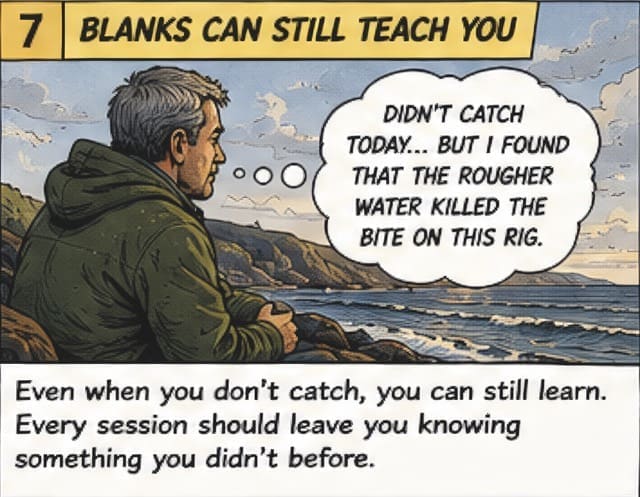
Instead, ask what the session taught you. Perhaps rougher conditions made your usual presentation ineffective. Maybe moving 100 yards made no difference, or a bait you’ve always considered second choice consistently produced the only indications.

Even discovering that something didn’t work has value because you’ve tested an assumption. Two anglers can walk off the same beach after catching nothing and have had very different sessions. One goes home knowing exactly what he knew when he arrived. The other leaves with information that will influence how he fishes next time. Neither caught a fish, but only one improved.
MAKE YOUR NEXT SESSION COUNT
The difference between an angler with 30 years’ experience and somebody who has effectively repeated the same year’s fishing 30 times isn’t the number of sessions they’ve completed. It’s what they’ve learned from them.
Improvement inevitably becomes harder as we become more experienced because we’ve already learned the obvious lessons. The gains become smaller, subtler and harder won, which is exactly why experienced anglers need to become more curious rather than less.
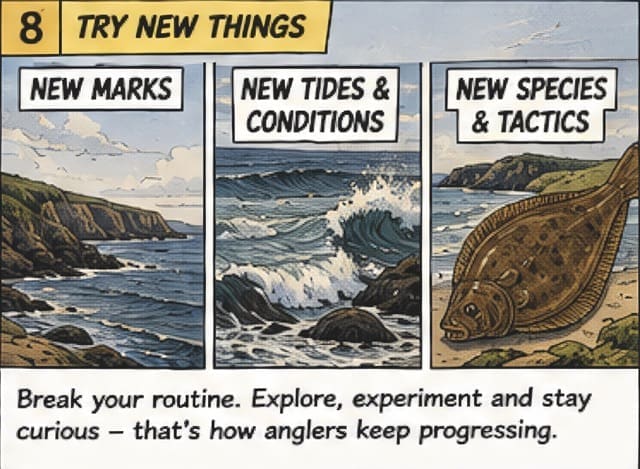
You probably don’t need another rod, another rig or another 20 yards on your cast to break through your plateau. Start by questioning some of the things you’ve come to regard as facts.
Test something. Interpret what happens. Decide what that tells you and execute your next move properly. Then repeat the process. Your fishing hasn’t reached its limit. You’ve simply reached the point where improvement needs to become deliberate.

MAKE YOUR NEXT FIVE SESSIONS COUNT
Give yourself one question to answer on each of your next five trips:
1. Distance: Do I really need to cast this far?
2. Bait: Is my favourite bait the most effective?
3. Tide: Does this mark fish better at another stage of tide?
4. Location: What happens if I move 100 yards?
5. Presentation: Can a different presentation produce more or better fish?
Don’t judge these sessions purely by what you catch. Judge them by what you know at the end that you didn’t know at the beginning.