
With a season of autumn and winter storms approaching James Batty explains how to make the most of the great bass fishing that comes during or after a big blow!
There are still people who say there’s no such thing as climate change, but mostly they fall into two camps: political operators funded by the oil companies and the Gulf States, and a few odd bods who believe the earth is flat and the Met Office is run by subterranean dinosaurs from Uranus. As anglers we can see that things are changing. On my patch we used to view gilthead bream as summer visitors from the Mediterranean, now they winter over and breed here. In the summer and autumn giant bluefin tuna often chase mackerel and herrings within a few hundred metres of the shore. Different types of jellyfish show up to give the open water swimmers more varied stings. And above all, we have a lot more storms.
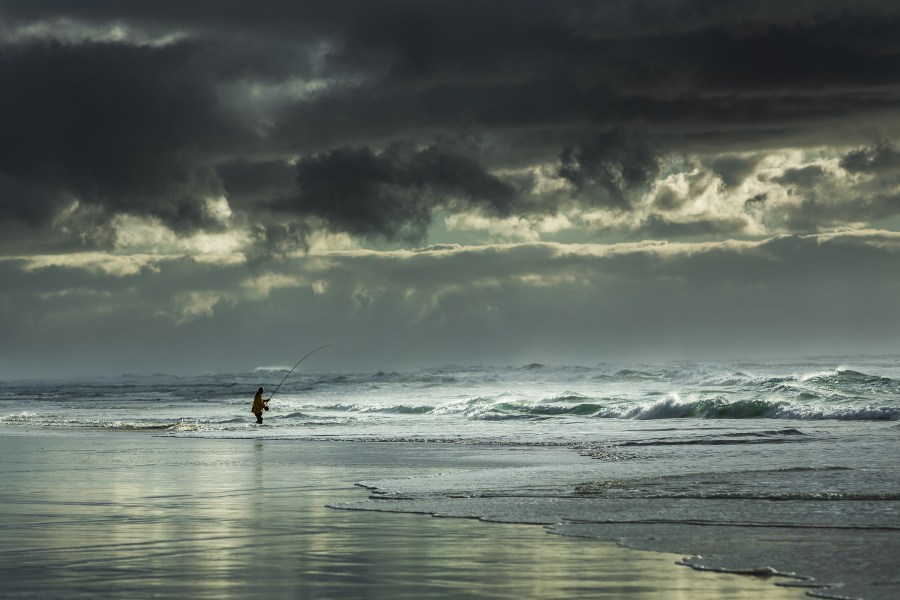
I love a good storm. Of course, my heart goes out to the upcountry people I hear on the radio, living in their upstairs bedrooms and pulling on waders to go down to the kitchen for a cup of tea. But wild weather means wild waves, and most of my big bass have come from the sort of surf that attacks the sand like a heavyweight boxer with anger management issues. Rough stuff? Bring it on, I say. One caveat: we all have a responsibility not to put ourselves in danger, the lifeboats and rescue helicopters have enough to do already. So before setting wader on a mark, you need to watch – for quite a while. Sometimes the waves seem to be coming in on a steady rhythm, and you think you can see how far up the strand they’re reaching, where it would be sensible to stand. Not so fast: now and again there’s going to be an unexpected monster, and your safe spot will disappear under a few feet of sucking surf. When I was a youngster the old salts talked about the seventh wave being the giant, but I don’t think they were right. I think it’s down to the fact that we have regular waves, whipped up by the current weather; and we also have big swells rolling in from the Atlantic. When a swell and a wave arrive at the same time, that’s when the whole beach disappears underwater.
An example, and I’ve spun this yarn before in one of my books “The Song of the Solitary Bass Fisher”, but I can’t resist telling it again: I was on a north-facing beach after a total hoolie, and I could see it was too rough to fish safely. But the tide was ebbing, and I hoped lower water might lead to calmer conditions, so I stuck around. Then I saw a torch coming across the sand. It was a young couple from the midwestern USA, on holiday, jet-lagged and unable to sleep. I advised them to stay off the beach and take their stroll on the dunes, and as we were talking, to reinforce my point, a massive swell-cum-wave pounded the shore. A while later the torch came back along the dunes, carried by the young woman. The young man was running down the strand as a wave receded, then turning to race back up as the next one arrived, hooting and laughing all the while. Of course he was caught, knocked flat by a few tonnes of water, and in the moonlight I could see him lying face down in the receding froth, either winded or concussed. I took my sand-spike as a wading staff, scurried out, turned him over, and dragged him up to the foot of the dunes, congratulating myself for recovering him from the drink without even getting wet; at which point another wall of water knocked me over, filling my trouser waders. The young chap was OK by this time, shaken and spewing up a lot of brine, but OK; so I suggested we go to the carpark to towel ourselves off. My car always has a fair amount of junk in it – tackle, clothes, and so on – so I offered him a dry fleece, but his bed and breakfast was close by and he insisted he didn’t need one. Then the couple asked if they could pay me for the rescue. I told them not at all, just shove something in a charity box, and I headed home for a warming shower. I wrote up my little adventure on a fishing forum, then I thought no more about it; until a few months later when someone in the Midwest sent me a copy of a letter to his local paper. The letter was from the young woman, and it praised Cornwall to the skies: lovely scenery, lovely food, lovely people – including a local chap who had rescued her fiancé from certain death, then refused payment, even though he was a homeless fisherman living in the back of an old Nissan Micra. My fifteen minutes of fame, and I ask for no more.
BOUNCING JIGS
But back to fishing, and when it’s really rough I would no more venture onto a rock mark than I would go to the supermarket clad in nothing but a jockstrap and a bowtie. And on the beach I’m going to use a big bait, a wired lead to keep it in the water. But I’ve had a few sessions with lures in the surf, most when I was still working overseas, and I came home to find nothing in the bait freezer. In a moderate wave you can catch bass from the strand with a hefty paddle-tail shad, flinging it out, then bouncing it back along the bottom. No evidence, but I suspect the puffs of sand may attract the predators, or perhaps their lateral lines pick up the little thumps as the jig-head touches down. However, when it’s really wild a paddletail puts up wind resistance, and I find it hard to cast it far enough. That’s when I go to a mackerel jig, usually a 40 or 50 gram effort – weighty and aerodynamic. When I’m after bass I always change the treble hooks on my lures for big singles; this makes it easier to unhook my fish. And on flat sand there’s another reason: a treble’s a bit like an anchor: as you retrieve the lure on or close to the bottom, it keeps hanging up. A single’s more likely to slide along.
One morning I was bouncing a 50-gram jig through the wildest of waves. The beach was flat, and even with an almighty heave I was getting the lure only into about two feet of water – when the wave was in. When it was out my gear was high and dry. But I’d managed a couple of half decent fish when I ran into a visiting angler with a lure rod in his hand. He’d taken a look at the rocky point at the end of the sand and decided – full marks to his judgment – that it was a death trap; so now he was just going for a constitutional to avoid getting home too early and waking up his partner – good judgment again. He watched me with a mixture of interest and incredulity, the look you’d expect if I’d been knitting a kilt from seaweed. And then I beached a three pounder, so he joined me in my odd pursuit. His rod was a good deal shorter and lighter than mine, but he had some Japanese jigs where most of the weight is in the hook end; they flew into the wind like laser-guided sandeels, and they yielded a few fish too, which was a few more than he’d expected.
STORM RUN-OFF
There’s one downside to stormy weather: heavy and persistent rain. I don’t mind being out on wet nights. I’m not one of those infuriating people who say, “There’s no such thing as bad weather, just the wrong clothes.” When east winds bring a freezing winter blast, I don’t care what you wear, your hands are going to turn blue and you’ll struggle to tie on a new rig with fingers like deep frozen chipolatas. But rain doesn’t worry me, my waterproof jacket overlaps my trouser waders; and as long as I keep my back to the wind, my hood does the rest. However, in some of my spots a real downpour can put the bass off the feed. A couple of my beaches are overlooked by cliffs made of iron-rich orange soil, which washes into the sea. A couple more are crossed by giant pipes that carry away the surface water from roads and carparks. So a long, wet spell leaves the surf full of tomato soup mud or dirty water. I don’t think fresh water in and of itself makes much difference to a bass, I’ve caught them a long way up trout streams where there’s no trace of saltiness. Rather, I reckon it’s the temperature. Thanks to the Gulfstream, the ocean in Cornwall is pretty warm, but by the time the autumn storms kick in, the rain’s distinctly chilly, and I think my fish swim out to sea to keep themselves cosy. The only way around this problem is to fish around low water on beaches that are very flat. If there’s a quarter mile stretch of sand between the runoff and the water’s edge, this seems to absorb a lot of the stuff that’s cold, grubby, Donald Trump coloured, or all three.
BIG BLOW: BIG BAIT
For me, at least the classic way to fish during or just after a wild blow is with a big bait – a whole squid, half a mackerel, or a lumpy mess of razor clams – in shallow, stirred up surf. Cast too far into the deeper, slightly calmer stuff and you can catch plenty of smaller bass, but the real whoppers aren’t put off by water that looks like the aftermath of an undersea train wreck. One morning I was parking beside the beach when a police car pulled up alongside me. I think the coppers expected either a drunk driver or a boy racer, who else would be loopy enough to be out and about at three in the morning in a forty-knot wind and a persistent horizontal drizzle? But once they saw my rod they realised I wasn’t criminal, just irremediably daft. Walking down to the water’s edge was hard work, the gusts were catching my waterproof coat and turning it into a drogue. Casting a big fat squid was a challenge as well, I had to wait for the end of a gust, then give it some serious wellie. And even with a 4oz wired lead it was tough to keep the line tight, I needed to keep raising and lowering the rod to allow for the drag on my braid. But three chucks led to two bass, one about five pounds, the second right on twelve. I didn’t weigh it. I don’t have a sling, and I think lifting a big fish with one of those Boca grips can’t be good for it. I know I’d be seriously narky if some giant from an alien species picked me up by my jaw and swung me around in the air. Anyway, I’m prepared to trust my special tape measure, the one that converts length into mass.
And to be blunt, I don’t care that much exactly what she weighed, she was an absolute cracker. One of the policemen had been watching me with his little boy’s toy night vision binoculars, and he agreed.